When cataracts begin to cloud your vision, even simple tasks like reading labels, checking your phone, or driving can feel harder than they should. Many people also wonder if cataract surgery could lessen their reliance on glasses at the same time.
Thanks to modern lens implant technology, cataract surgery can sharpen your vision at various distances and support the way you use your eyes day-to-day.
At the Eye Care Institute in Santa Rosa, California, our board-certified ophthalmologists and experienced optometrist use advanced diagnostics and surgical methods to help you reach clearer, more dependable sight. Their training and experience shape every decision, giving you care that is truly centered around your needs.
Lens Implant Options
Toric Lens Implant for Astigmatism
Toric intraocular lenses (IOLs) correct nearsightedness or farsightedness and regular astigmatism. Unlike standard spherical implants, toric lenses feature specialized optics that neutralize astigmatism by several diopters. Reducing astigmatism during cataract surgery helps patients see more clearly at distance or near with less dependence on prescription glasses.
During your evaluation, your surgeon will determine whether a toric lens is appropriate for your eye’s measurements.

Multifocal Lens Options
Standard monofocal lenses focus at one distance only—usually far. Multifocal implants are engineered with diffractive optics that allow the eye to see at both near and distance ranges with less reliance on glasses.
Tecnis® Multifocal Lens
This implant provides two focal points: one for distance and one for reading. Many patients with little to no astigmatism are able to function without glasses after surgery. FDA studies report that more than 80% of patients with this lens felt they no longer needed glasses for most daily tasks. Those who still use glasses typically need them for intermediate activities such as computer work.
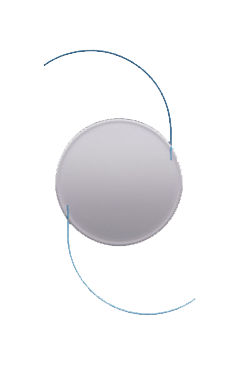
ReSTOR® Multifocal Lens
The ReSTOR® lens also supports clear vision at multiple distances through alternating diffractive zones. Some patients may experience halos or glare at night, though current-generation designs have reduced these effects significantly.

Extended Depth of Focus (EDOF) Lens
AMO Symfony® Lens Implant
Unlike traditional multifocal lenses, EDOF implants create an extended focal zone that delivers smooth, continuous vision across far and intermediate distances. This design helps maintain contrast sensitivity and reduces the chance of halos or glare.
Patients often experience excellent distance vision and strong computer-range clarity, with many achieving good functional near vision as well.
Accommodating Lens Option
Crystalens® Implant
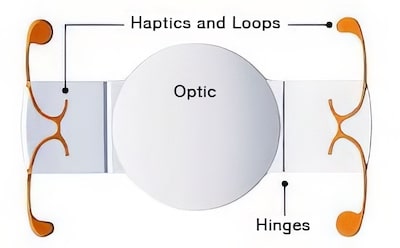
The Crystalens® IOL features flexible hinges that respond to the eye’s natural focusing muscles. This allows the lens to shift slightly inside the eye to improve range of focus.
Crystalens® typically provides strong distance and intermediate vision with minimal night glare. Some patients may still need reading glasses for fine print or very close work.
Why Choose Eye Care Institute?
The Eye Care Institute brings together a team of board-certified ophthalmologists and a highly trained optometrist who specialize in modern cataract care, advanced lens implants, and customized visual correction. Their combined expertise allows patients to receive recommendations based on careful evaluation, lifestyle needs, and the latest surgical technology. Every surgeon at ECI is experienced in implanting a wide range of premium lenses and matches each patient to the lens that best supports long-term visual results.
Patients also benefit from the practice’s commitment to clinical excellence and safety. The team uses advanced diagnostics to measure the eye and guide surgical planning. At every step—from initial testing to postoperative care—you’ll receive clear explanations and a supportive environment focused on maximizing vision and eye health. This dedication has made the Eye Care Institute a trusted resource for cataract and refractive care in Santa Rosa and the surrounding communities.
Frequently Asked Questions
How Long Does It Take to Adjust to a Multifocal or EDOF Lens?
Most patients adjust to a multifocal or extended depth of focus (EDOF) lens over the course of several weeks. Your brain and eyes work together to interpret the new visual system, and this “adaptation period” is a natural part of healing. Some people adjust quickly, while others notice gradual improvement in clarity over a few months.
What Visual Side Effects, Such as Halos or Glare, Should I Expect With Different Lens Types?
Some patients notice halos or glare around lights at night after receiving a multifocal lens. These effects are typically mild and tend to lessen as the brain adapts to the new optics. EDOF lenses are designed to reduce the likelihood of glare and halos compared with traditional multifocal lenses.
With accommodating lenses like Crystalens®, nighttime symptoms are usually minimal. Your surgeon will discuss what to expect based on your eye health and the lens you choose.
Can Different Lens Types Be Used in Each Eye to Fine-Tune Vision?
Yes. In some cases, choosing different lens types for each eye can improve your overall range of vision. For example, one eye may receive a lens that emphasizes distance vision, while the other supports intermediate or near vision.
This approach, sometimes called “blended vision,” can be helpful for certain patients. Your surgeon will determine whether mixed lens strategies are appropriate for you.
How Do I Know Which Lifestyle Lens Implant Is Right for My Daily Activities?
Your surgeon will recommend a lens based on your eye health, the measurements taken during your evaluation, and how you use your vision throughout the day. Some patients spend significant time on the computer, while others prioritize reading, driving, or outdoor activities.
Discussing your routines and visual preferences helps your surgeon match you with the most suitable option.
Are Lifestyle Lens Implants Covered by Insurance or Considered an Elective Upgrade?
Standard monofocal lenses are covered by insurance when used for cataract surgery. Lifestyle lenses are considered elective upgrades because they aim to reduce dependence on glasses.
Insurance typically covers the cataract surgery itself, while the additional cost of the premium lens and related testing is paid out of pocket. Your care team can review pricing and answer any questions before scheduling surgery.
Schedule a Cataract Consultation
Clearer vision begins with understanding your lens options and how they fit your daily life. To learn more or schedule a visit to the Eye Care Institute in Santa Rosa, CA, call 707.546.9800.